
Critical Thinking Ruins Journalistic Integrity [Not Clickbait]
- Mar 25, 2018
- 5 min read
(Believe it or not, writing that title actually caused me physical pain. If fake news is sacrificial of journalistic integrity, clickbait titles demolish an informative writer's pride in credibility.)

It's no secret that "fake news" has been a popular accusation among politicians and skeptics recently—take a peek at President Trump's twitter and it's a trending topic—but the issue itself is a complicated and an old one. People claiming to be an unbiased third party have been stretching the truth for years, whether they do it with the intent to fit a narrative or just interpreting the information as they see it, overlooking important details in the mix.
Consider the following timeline depicting "fake news" in modern history:
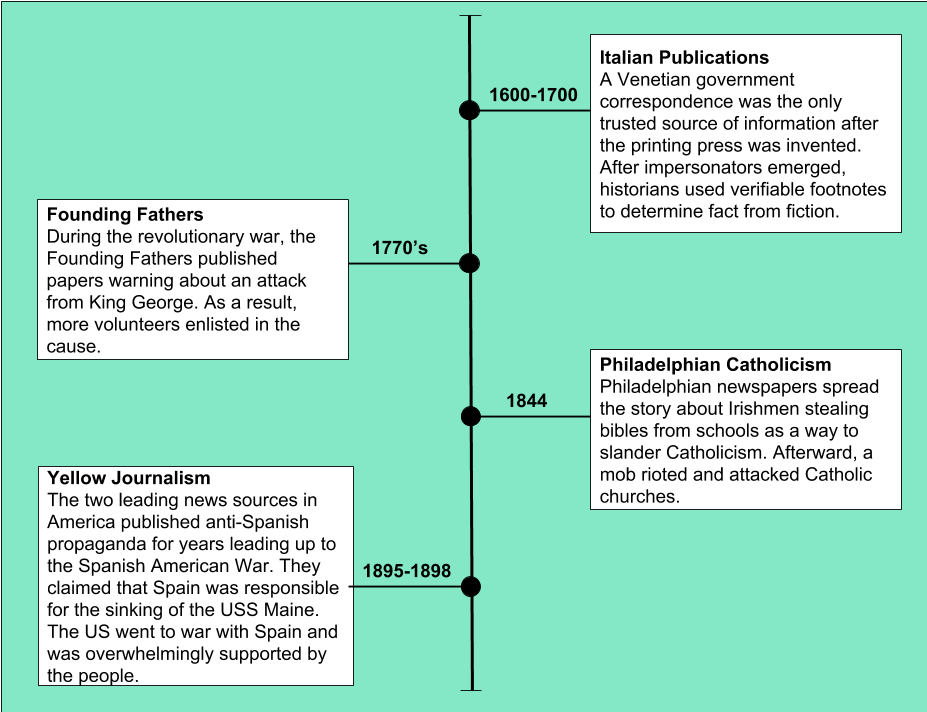
Though these are just a few examples, they show just how prevalent journalistic inaccuracies have been throughout history and the effects that new sources have on society. In fact, during the 2016 election, news became downright propagandistic.
Allow me to defend this hefty claim. A work can be considered propagandistic if it...
Seeks to channel thinking into one single belief
Bends the truth to meet an agenda
Relies heavily on pathos or emotional reasoning
Sound familiar? Let's put it in context.
During the 2016 election, all news stations besides Fox News backed candidate Hillary Clinton. While it is not inherently bad for an independent company to support a political candidate, it is troublesome when all the news produced by this company either praises or vilifies the candidates themselves and the people who vote for them. A majority of the campaign behind Hillary Clinton held up the argument that Trump was alt-right and evil and so was anyone who voted for him. It championed Clinton as brave for running against him and standing for progress and equality, and, as the correct and only choice for the common American, there was no way she wouldn't win, right?
Fox news fell to the same pitfalls. According to them, those who voted Clinton were voting for the same old corruption and just had to be uneducated or entitled. Anything incriminating that came out against Trump could be brushed aside as slander and nothing more. Clearly, anything that disagreed with them and theirs had to be looking through some distorted lens. They were just "Fake News."
"Allowing agenda based media to form an echo chamber closes minds and turns the world into a divisive sea of us or them, right or disgusting, rather than a complex world full of individual paradigms based on past experiences."
The political divide shattered the humanity of experience, making a choice between justice or mercy. Allowing agenda based media to form an echo chamber closes minds and turns the world into a divisive sea of us or them, right or disgusting, rather than a complex world full of individual paradigms based on past experiences. People seldom wake up in the morning with the intent to be bigoted or demeaning. Everyone is entitled to their own worldview, but that entitlement is voided when they use their opinions to silence other voices with different worldviews. In fact, anyone who does so while claiming to be informed on a subject clearly is not as informed as they think. Being "informed" is another way of saying they're right, as any opposition would have to be, by definition, uninformed. We must be open minded enough to consider that what we believe or are told to believe may be wrong.
(If your first thought was to consider that what I'm saying may be wrong, I commend you.)
So, how do we combat news that utilizes propagandistic tactics to spread a narrative? Follow this simple three step program:
One
Meet Your Maker
Do some research on the creators of the content you consume and find out their political leanings and corporate affiliations. Before you trust a bank to handle finances, odds are you do research on its reputation to ensure that the one you choose has no history of corruption or mistreatment of its customers. You wouldn't trust money to a banker with whom you're unfamiliar, so why would you entrust the gathering of information to a source you don't know?
Before ascribing credence to a news company, make sure they deserve your trust as a whole. What is their history as a company? Have they spread misinformation without running a correction? You need to know about the people you trust to shape your worldview.
Two
See Other People
Don't just get news from one source consistently. Consult other sources to get a wider spectrum of ideas and information presentation. You don't have to agree with a news source's political leanings to listen to them. In fact, listening to other opinions will either reaffirm what you believe or open up the possibility that you were incorrect. Learning is healthy.
I would suggest also consulting online private media outlets; while they have their own biases, they generally aren't owned by one major corporation and have fewer hands in the metaphorical bucket. If their accuracy of their content is questionable, consult step one. Do your research and find out more about their credibility. Use these sources as a safeguard. If you diversify your information sources, you'll get a good enough picture of the information, and, if there are discrepancies in reporting, dig a little deeper for the truth and re-evaluate the ones you trust.
Three
Think Like a Skeptic
Approach every piece you read with a healthy dose of skepticism. Every news source may have its bias, but that doesn't mean that every news source is lying. To orient yourself in the sea of messages that could be hidden in a particular work, ask yourself:
What is the creator's purpose?
What does the creator want me to believe after consuming this?
What does the creator want me to do after consuming this?
If the purpose of the work is to coerce you into believing one specific thing, it probably isn't worth consuming. If you choose to consume works with heavy bias, make sure you're aware of this bias before you take in their content. Being aware that someone has a bias can help you keep your own thoughts and opinions safe from being swayed by heavy propaganda. However, even people who are blatantly biased can still have a good point persuasively. Just make sure that if you find yourself agreeing, it's because you agree with the argument, not the rhetoric.
Ultimately, we have a right and responsibility to demand factual material from what we consume. I'm not saying we picket at the step of sources with bias, but, as consumers, we can tell them what we want with our wallets. The news sources that bend the truth will get the message once their subscriber count prevents them from keeping the power on.
Comments